Club Militar venue
My Tender MatadorClub Militar venue matters as both the setting of Augusto Pinochet and Lucy’s first meeting and the site of a later birthday celebration staged around him. Its two appearances set a modest beginning—a conversation at a party—against the extravagant ritual surrounding the dictator, making the venue a point where private memory and public status meet.
First Meeting
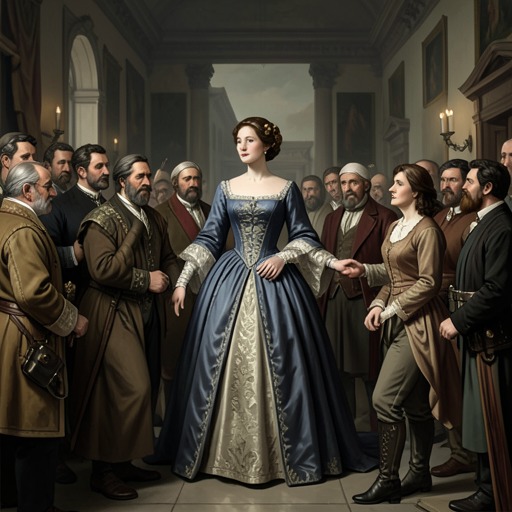
Lucy was seventeen, a recent graduate of a Catholic school from a small provincial town, when she attended her first party at Club Militar venue. In a flowered lace dress, she sat apart from the gathering. Augusto Pinochet asked her to dance, but she objected that the music was a military march and that dancing to it would insult the armed forces. He sat down beside her to talk instead. The narration identifies this exchange as the beginning of their relationship, which led to marriage.
The meeting places Lucy’s youthful reserve within a military social setting, while her response to the music gives their introduction a note of independence. The institution’s presence is not incidental: their conversation begins with a disagreement over how a military march should be treated, before developing into courtship.
Birthday Ceremony
Club Militar venue appears again as the destination for a birthday celebration for Augusto Pinochet. Lucy describes an eleven-layer cake to be brought by women from the Chilean Women’s Auxiliary, made with the labor of their employees and decorated with crossed marzipan swords. She considers what to wear, weighing a cream-colored dress against a mustard-colored Chanel gown she has never worn. The details turn the gathering into a carefully prepared ceremony of display, with military imagery built into the cake itself.
That spectacle contrasts with Pinochet’s remembered dislike of birthdays. As a child, he hated cakes and presents after an earlier birthday experience, and he wanted toys for his collection rather than parties or surprises. The adult celebration at Club Militar venue therefore carries an irony: an elaborate public event is being arranged for someone whose recollections associate birthdays with disgust and disappointment.
Narrative Significance
The venue connects distinct stages of the marriage without making them equivalent. At the first party, it frames an encounter that begins in conversation; later, it hosts a formal celebration organized around Pinochet’s public position. The contrast between Lucy’s youthful lace dress and her later deliberation over designer clothing, and between a simple first exchange and an eleven-layer cake, gives the location a role in marking the passage from courtship to ceremonial life. It also shows how the novel lets domestic memory and military symbolism occupy the same social space.